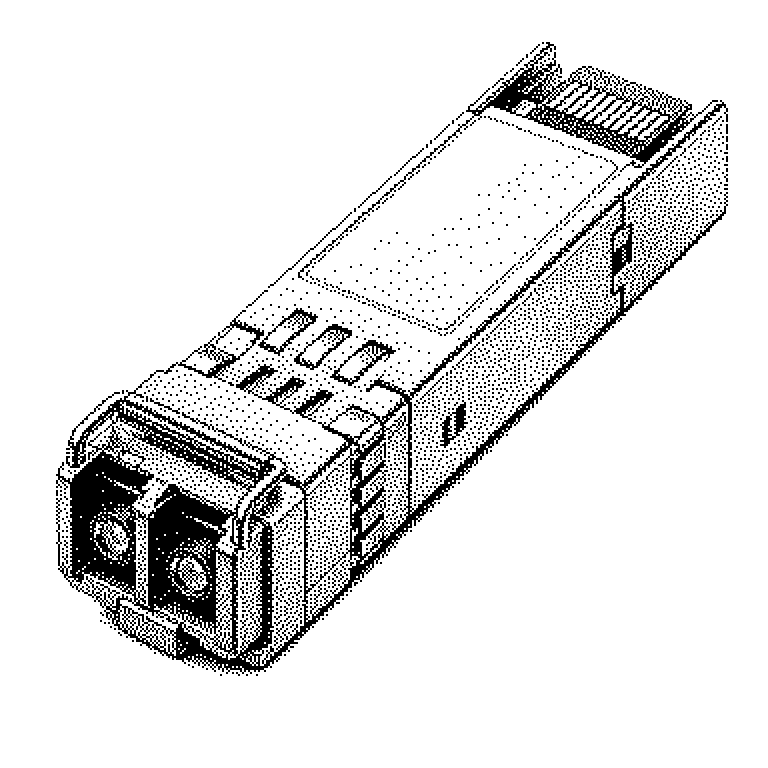
Optical Transceiver Modules
Optical transceiver modules are small pluggable components that translate electrical signals into light signals and vice versa. They connect computers and network devices via fiber optics and are thus a central component in artificial intelligence data centers.
Computers work internally with electric current. Over long distances, however, copper cables are poorly suited for this because the signal quickly weakens and becomes less precise. That’s why data is sent over fiber optics, meaning through thin glass strands in which light travels instead of electricity. It is exactly at this boundary that an optical transceiver module sits: a small component, about the size of a USB stick, that is plugged into the front of a network device. It converts electrical signals into flashes of light and, at the other end, converts them back again. The name comes from English and combines “transmitter” for sender and “receiver” for receiver, because the module can do both at the same time.
Why AI data centers depend on these plugs
A large AI model is not trained on a single chip. Tens of thousands of specialized chips run in parallel, and each of them must constantly exchange intermediate results with all the others. These chips sit in many racks distributed across an entire data center floor. Each of these connections requires an optical module at both ends.
This creates a volume effect that many underestimate. A single large data center contains hundreds of thousands of such modules. Depending on speed, they cost anywhere from a few hundred to over a thousand euros apiece. In total, this is an item that, alongside the actual AI chips, weighs heavily in the construction costs.
Then there’s the power consumption. A single module draws only a few watts, but with hundreds of thousands of units, this adds up to several megawatts. This is why network technology now plays its own role in reports on AI data centers and is no longer treated as a side issue.
From electrical signal to flash of light and back
The transmitting section contains a tiny laser diode. It is switched on and off extremely quickly, thereby generating a sequence of light flashes. Light on means a one, light off means a zero. In modern modules, this happens several billion times per second.
The receiving section contains a photodiode. It does the opposite, converting incoming light back into an electrical pulse. A small chip inside the module then cleans up the signal, since it becomes distorted along the way. You can think of it like a translator who not only switches languages but also turns unclear mumbling back into clear sentences.
To fit more data through a single fiber, several colors are used at the same time. Each wavelength carries its own data stream without the streams interfering with one another. A common misconception is that the number in a module’s name indicates its range. What is almost always meant is the speed: 800G stands for 800 gigabits per second, roughly the content of twenty feature films per second.
Where the modules show up in products and stock market news
In everyday life, one encounters a related technology with home fiber-optic connections. The white box on the wall contains essentially the same idea at its core, just slower and cheaper. The fast pluggable modules, by contrast, are seen almost exclusively in the server racks of companies and data centers.
In business news, the modules appear under names like QSFP or OSFP. These are standards for form factor and connector slot. They ensure that a module from manufacturer A fits into a switch from manufacturer B, meaning a device that distributes data packets across the network.
It’s important to distinguish these from the fiber optic cable itself. The fiber is merely the passive cable and is left in place for decades. The modules are the active electronics at the ends and get replaced with every jump in speed. That is precisely why the stock prices of module manufacturers react strongly when a corporation announces the construction of new AI data centers.