Public Benefit Corporation
A Public Benefit Corporation is a US legal business form that, according to its own charter, must pursue not only profit but also a specified benefit for the general public. The form became well known through AI companies like Anthropic and xAI as well as through OpenAI's restructuring plans.
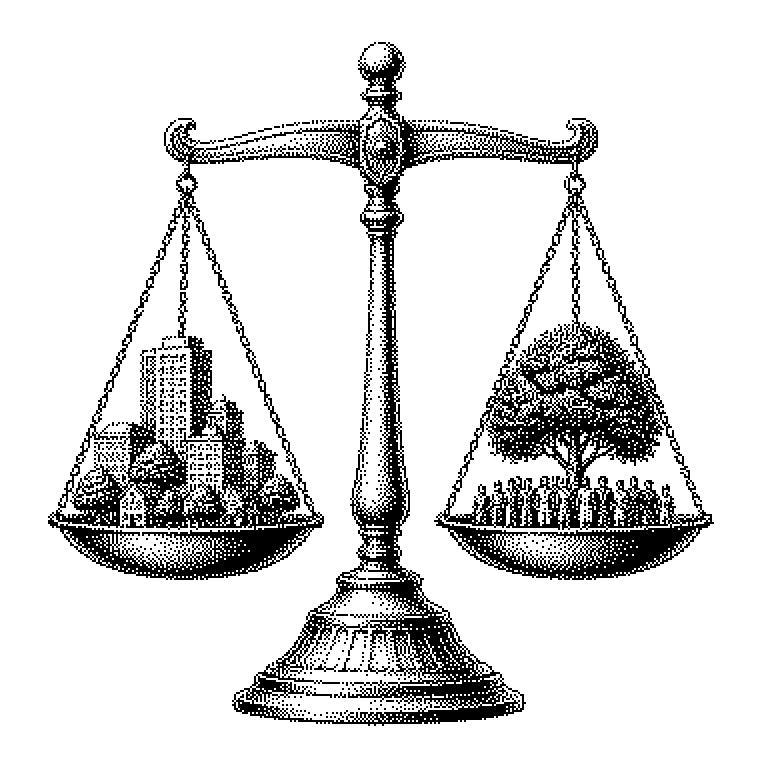
Anyone founding a company in the US chooses a legal form for it. It determines who owns the company, who makes decisions, and what the leadership is obligated to pursue. In a normal corporation, the interests of the owners are at the center, meaning usually profit. The Public Benefit Corporation is a variation on this. It is likewise a for-profit enterprise with owners and shares, but it must additionally write a self-chosen public-benefit goal into its founding charter. The leadership may and should weigh this goal against short-term profit interests. The closest German term for this would be “Gesellschaft mit öffentlichem Zweck,” but there is no exact equivalent in German law.
Why AI companies turn to this legal form
Many companies in the AI industry claim to be working on a technology that could be risky for humanity. At the same time, they need billions from investors to pay for data centers and chips. These two things fit together poorly. A purely profit-driven business would, in case of doubt, always have to choose the faster and more lucrative product.
The Public Benefit Corporation is meant to cushion this contradiction. Anthropic, for instance, names the safe and beneficial use of advanced AI as its purpose. For management, this means: if it holds back a product because it considers it unsafe, it can point to the charter. In an ordinary corporation, lawsuits from shareholders would be easier to bring in such a case.
It is important to distinguish this from a non-profit organization, i.e., a charitable association or foundation. Such an entity is not allowed to distribute profits to owners, whereas a Public Benefit Corporation very much is. So it is not a charitable project, but a company with an additional obligation in its founding document.
What the charter states and who enforces it
Most of these companies are registered in the US state of Delaware, because corporate law there is particularly well developed. The law requires three things. First, a specific public benefit must be named in the founding charter. Second, the leadership must balance profit, the interests of affected third parties, and this benefit against one another. Third, the company must report regularly on its progress, at least every two years, to its shareholders.
However, oversight is weaker than the name suggests. There is no authority that checks whether the promised benefit is actually being achieved. Only shareholders are allowed to sue, and in practice only larger ones. A citizen who feels harmed by an AI product cannot invoke the charter. The report does not even have to be published.
Some companies therefore build in additional safeguards. At Anthropic, a Long-Term Benefit Trust — a trustee body of independent individuals — controls part of the seats on the oversight board. Such constructions exist alongside the legal form, not within it. Critics consider the form, taken by itself, to carry little binding force and call it a self-commitment with a legal veneer.
The form in company names and headlines
The suffix “PBC” barely appeared in business news for a long time. That changed with the AI boom. Anthropic, the developer of the chatbot Claude, is a Public Benefit Corporation. Elon Musk’s company xAI is one as well. There are also examples outside the tech industry, such as the outdoor manufacturer Patagonia or the crowdfunding service Kickstarter.
The most discussed case was OpenAI. The company behind ChatGPT began as a non-profit organization and later built a for-profit arm underneath it. At the end of 2025, this arm was converted into a Public Benefit Corporation, controlled by a foundation. The dispute over whether charitable assets flowed to investors in the process occupied attorneys general in several states.
For readers of financial news, the form is interesting for a practical reason. When a Public Benefit Corporation goes public, investors buy shares in a company that, by charter, is not required to maximize its profit alone. A common misconception is to take the suffix as an audited seal of quality. It only describes an intention stated in the founding document, not confirmed behavior.