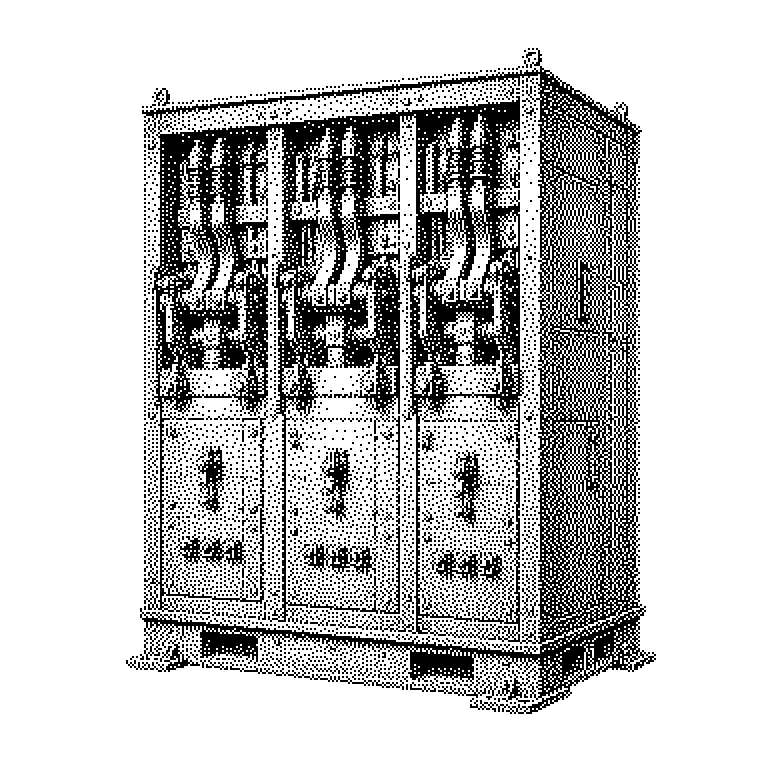
Switchgear
Switchgear refers to devices that distribute, switch on and off, and disconnect electrical power in large facilities in the event of faults. Because data centers for artificial intelligence require enormous amounts of electricity, such equipment has become a scarce and much-discussed component.
Switchgear is the technology used to distribute electricity in large buildings and power plants. It consists of switches, fuses, measuring devices, and steel cabinets in which everything is installed. Its task is threefold: to split power across many circuits, to de-energize circuits in a targeted way for maintenance, and to shut off power immediately in the event of a fault. The easiest way to understand it is as the fuse box of a house, just on a scale that fills entire rooms. Instead of a few kilowatts, such a system switches many megawatts — a thousand times more.
The bottleneck in data center construction
A modern data center for artificial intelligence consumes as much electricity as a small city. Individual planned facilities reach several hundred megawatts of capacity. This power arrives at high voltage and must be distributed to thousands of servers. Without switchgear, nothing works here, no matter how many graphics chips are sitting in the warehouse.
This is exactly where a bottleneck has emerged in recent years. Demand rose faster than manufacturers could expand their factories. Lead times of one to two years have become normal for large installations. In operators' quarterly reports, one therefore often reads that it is not money but equipment that determines the timeline.
For investors, this is a reason to take an interest in rather unspectacular electrical engineering conglomerates. Companies like Schneider Electric, Eaton, ABB, Siemens, or Hitachi Energy profit from the AI boom without training a single model themselves. Such behind-the-scenes beneficiaries are often called second-tier suppliers.
What’s inside the steel cabinets
The most important component is the circuit breaker. It can open a circuit even while a very high current is flowing. This is harder than it sounds: when disconnecting, an arc forms — a hot, conductive flame between the contacts. The breaker must extinguish this arc within milliseconds, or the equipment will melt.
Various techniques exist for this. Many breakers operate in a vacuum, because without air no arc can persist. Others use an insulating gas. For a long time this was sulfur hexafluoride, an extremely potent greenhouse gas that is now being phased out step by step in the EU. Manufacturers are therefore switching to alternatives using dry air, which has become a selling point in its own right.
In addition, there are disconnectors for safe working, busbars — thick copper bars — for power distribution, and transformers that measure voltage and current. Protective electronics monitor the measurements and trip the breaker if something falls outside normal parameters. A common distinction is made by voltage level: low voltage up to about 1,000 volts, medium voltage up to about 52 kilovolts, and high voltage above that.
From the substation to the server room
Switchgear is found wherever large amounts of electricity flow. In every substation on the outskirts of a city, in hospitals, factories, subway networks, wind farms, and on ships. It is rarely visible, since it sits in locked rooms or gray containers behind fences. The reason is simple: anyone who touches an open medium-voltage installation will not survive.
In business news, the term usually appears in its English original form. Typical are reports about new switchgear factories in Texas or India, record-high order backlogs, or data centers whose launch is delayed due to a lack of equipment. Transformers are also frequently mentioned in this context. They change the voltage, while switchgear distributes and disconnects the current — two different devices that are, however, usually ordered together.
A common misconception is confusing switchgear with a network switch. A network switch forwards data between computers and works with tiny currents. Switchgear carries energy and has nothing to do with data. Both are found in the same data center, but they belong to entirely separate worlds.